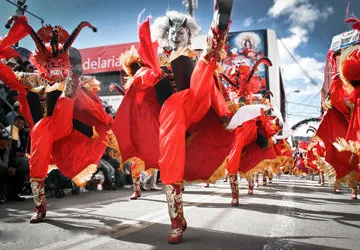
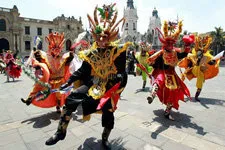
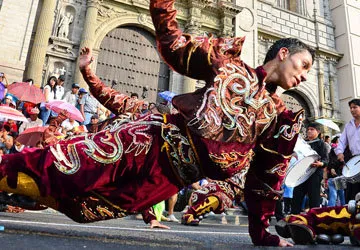
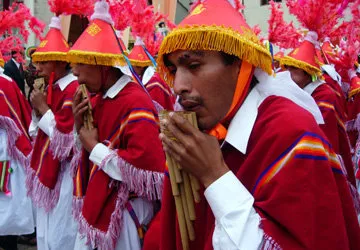
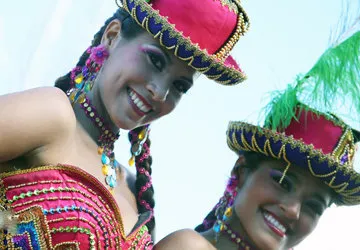
Diablada dancers during a Virgin of Candelaria parade

This Year's Events at the Virgin of Candelaria Festival in Puno

Mini. Posing with Virgin of Candelaria Festival in Puno, Per
Cover. Virgin of Candelaria Festival dancers in Puno, Peru
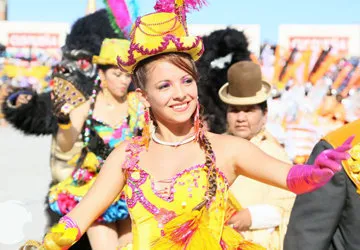
Dancing for the Virgin of Candelaria in Puno, Peru
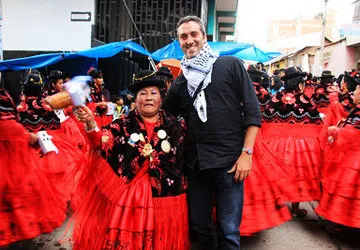
Posing with a woman in traditional Andean dress
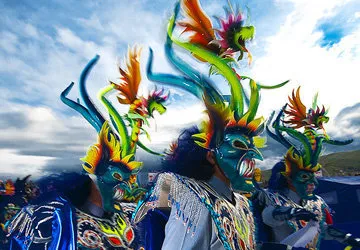
The Diablada dance hails from Lake Titicaca's surroundings
Even foreign travelers participate in honoring Puno's Virgin
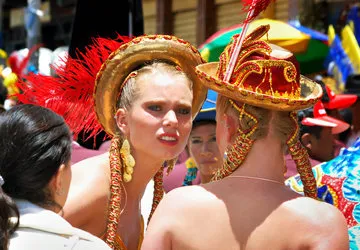
Intricate costumes are prepared for the festival
Sicuris, Andean Panpipers, during their February parade
Virgin of Candelaria dancers in Puno near Lake Titicaca

It's being estimated that more than 30 thousand foreign and domestic travelers will visit Puno this year to take part in one of South America's most sensational festivals. Arrangements for the massive event are well underway. Yesterday, Puno's Queen of Folklore was crowned, although the first large event will be the Entrance of the K'apus. Get the schedule here...

It's being estimated that more than 30 thousand foreign and domestic travelers will visit Puno this year to take part in one of South America's most sensational festivals, the Virgin of Candelaria Festival, which takes place the first two weeks of February each year.

The history of Puno goes back more than a millennia (its famed Floating Islands of Uros are home to what is perhaps the oldest living culture in the Americas). Spectators at the Virgin of Candelaria festival have the unique opportunity to witness hundreds of folkloric dances from different stages of this history: pre-Columbian dances from the Aymara and Quechua cultures, colonial mestizo dances with Spanish and African influences.

Arrangements for the massive event are well underway. Yesterday, Puno's Queen of Folklore was crowned, one of the events which kickstarts the weeks of festivities for the Virgin of Candelaria. The first large event will be the Entrance of the K'apus this Feb 1st, for which provincial governors from all over the Puno region are now preparing. The event is Peru's largest cultural manifestation, showcasing the wealth of music and dance styles in the country's folkloric capital.

More than 40 thousand dancers and 5 thousand musicians will take part in the festival's competitions and parades, the largest of which are listed here:

Candelaria Festival 2014: The Schedule

Jan 23rd  

The Queen of Folklore is crowned at the Coliseo Cerrado

Feb 1st    

12pm: Entrance of the K'apos, followed by ritual offering to the Pachamama

5pm: Procession of the Virgin of Candelaria (from San Juan Bautisa Sanctuary to Puno's Cathedral), followed by fireworks and festivities

Feb 2nd (Main Day)   

7am Indigenous Dance Contest at Estadio Enrique Torres Belón

2pm Main Parade, featuring Indigenous Dances by each of the rural countryside communities

Feb 8th   (eve of the Octava)

7pm Evening mass at the Sanctuary of the Virgen of Candelaria, followed by fireworks and dances

Feb 9th (the Octava)

7am Mestizo Dance Contest (Colonial & Republican era dances performed in traces de luces, bullfighters' dress)

2pm Parade, featuring Mestizo Dances by the barrios of Puno city proper

Feb 10th

8am Mestizo dance groups will perform in front of the church and through the city streets

Feb 11th   

Musical bands outdoor concert

Feb 12th   

Parade of Sicuris and Zampoñas (Andean panpipers)
It's being estimated that more than 30 thousand foreign and domestic travelers will visit Puno this year to take part in one of South America's most sensational festivals. Arrangements for the massive event are well underway. Yesterday, Puno's Queen of Folklore was crowned, although the first large event will be the Entrance of the K'apus. Get the schedule here...

It's being estimated that more than 30 thousand foreign and domestic travelers will visit Puno this year to take part in one of South America's most sensational festivals, the Virgin of Candelaria Festival, which takes place the first two weeks of February each year.

The history of Puno goes back more than a millennia (its famed Floating Islands of Uros are home to what is perhaps the oldest living culture in the Americas). Spectators at the Virgin of Candelaria festival have the unique opportunity to witness hundreds of folkloric dances from different stages of this history: pre-Columbian dances from the Aymara and Quechua cultures, colonial mestizo dances with Spanish and African influences.

Arrangements for the massive event are well underway. Yesterday, Puno's Queen of Folklore was crowned, one of the events which kickstarts the weeks of festivities for the Virgin of Candelaria. The first large event will be the Entrance of the K'apus this Feb 1st, for which provincial governors from all over the Puno region are now preparing. The event is Peru's largest cultural manifestation, showcasing the wealth of music and dance styles in the country's folkloric capital.

More than 40 thousand dancers and 5 thousand musicians will take part in the festival's competitions and parades, the largest of which are listed here:

Candelaria Festival 2014: The Schedule

Jan 23rd  

The Queen of Folklore is crowned at the Coliseo Cerrado

Feb 1st    

12pm: Entrance of the K'apos, followed by ritual offering to the Pachamama

5pm: Procession of the Virgin of Candelaria (from San Juan Bautisa Sanctuary to Puno's Cathedral), followed by fireworks and festivities

Feb 2nd (Main Day)   

7am Indigenous Dance Contest at Estadio Enrique Torres Belón

2pm Main Parade, featuring Indigenous Dances by each of the rural countryside communities

Feb 8th   (eve of the Octava)

7pm Evening mass at the Sanctuary of the Virgen of Candelaria, followed by fireworks and dances

Feb 9th (the Octava)

7am Mestizo Dance Contest (Colonial & Republican era dances performed in traces de luces, bullfighters' dress)

2pm Parade, featuring Mestizo Dances by the barrios of Puno city proper

Feb 10th

8am Mestizo dance groups will perform in front of the church and through the city streets

Feb 11th   

Musical bands outdoor concert

Feb 12th   

Parade of Sicuris and Zampoñas (Andean panpipers)
News, routes, and expert tips

Explore the latest from our Cusco travel blog. Get practical guides, Machu Picchu updates, and fresh trekking and culture recommendations. Everything you need to travel Cusco safely and stylishly in 2026. Your next Andean story starts here!

The festival starting Monday 28th that isn't touristy: San Jerónimo, 5 days

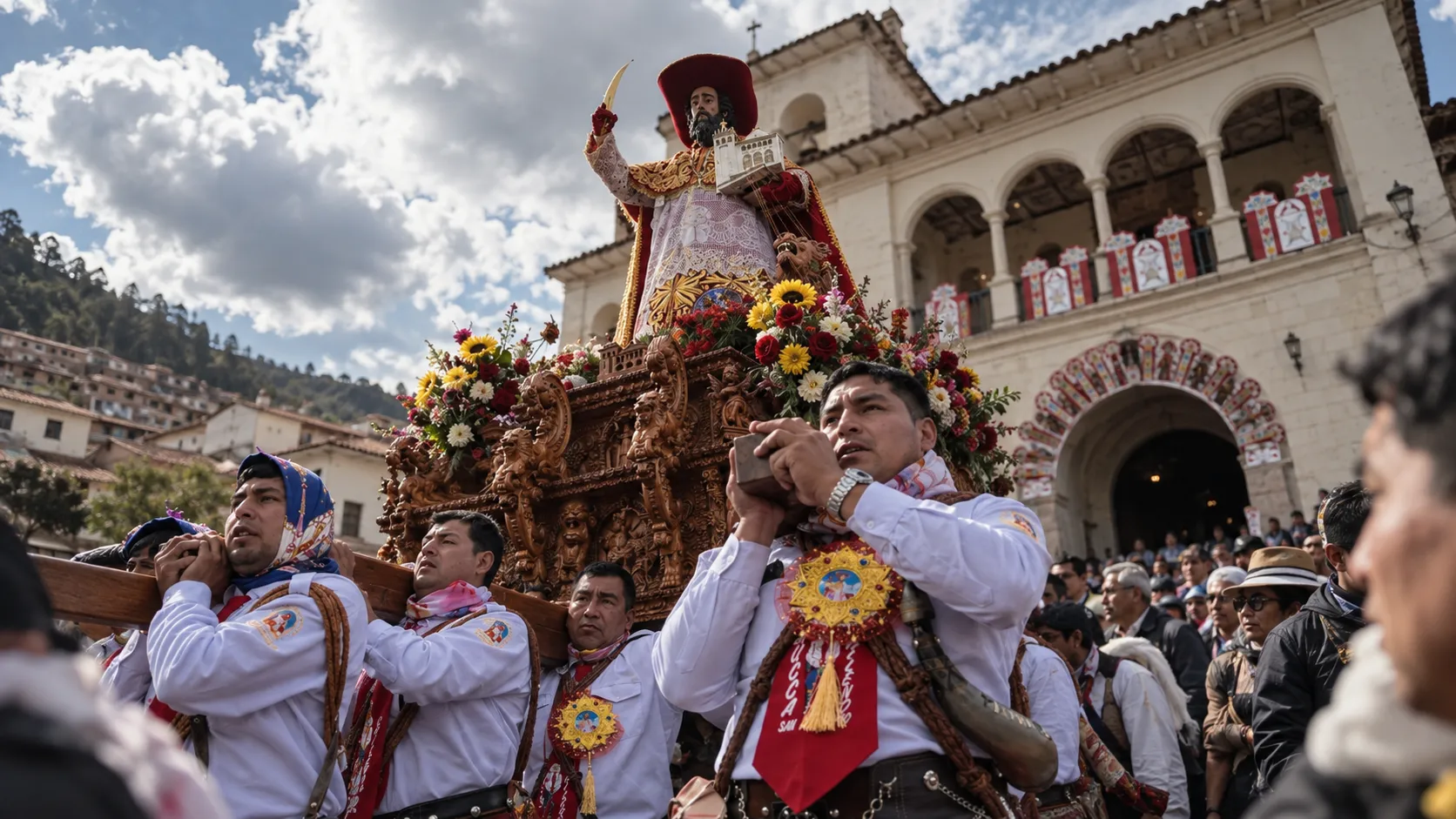
Just 11 kilometers from the Plaza de Armas, the historic district of San Jerónimo celebrates its patron saint every late September: 5 days of processions, 26+ dance troupes, a food fair, and a 16th-century church built on an Inca huaca. In 2016, it was declared Cultural Heritage of the Nation. Most tourists don't know it exists; many young locals don't either. This year it starts on Monday, September 28, with the main day on Wednesday 30.

1,500 young people in Sacsayhuamán competing as they did 500 years ago

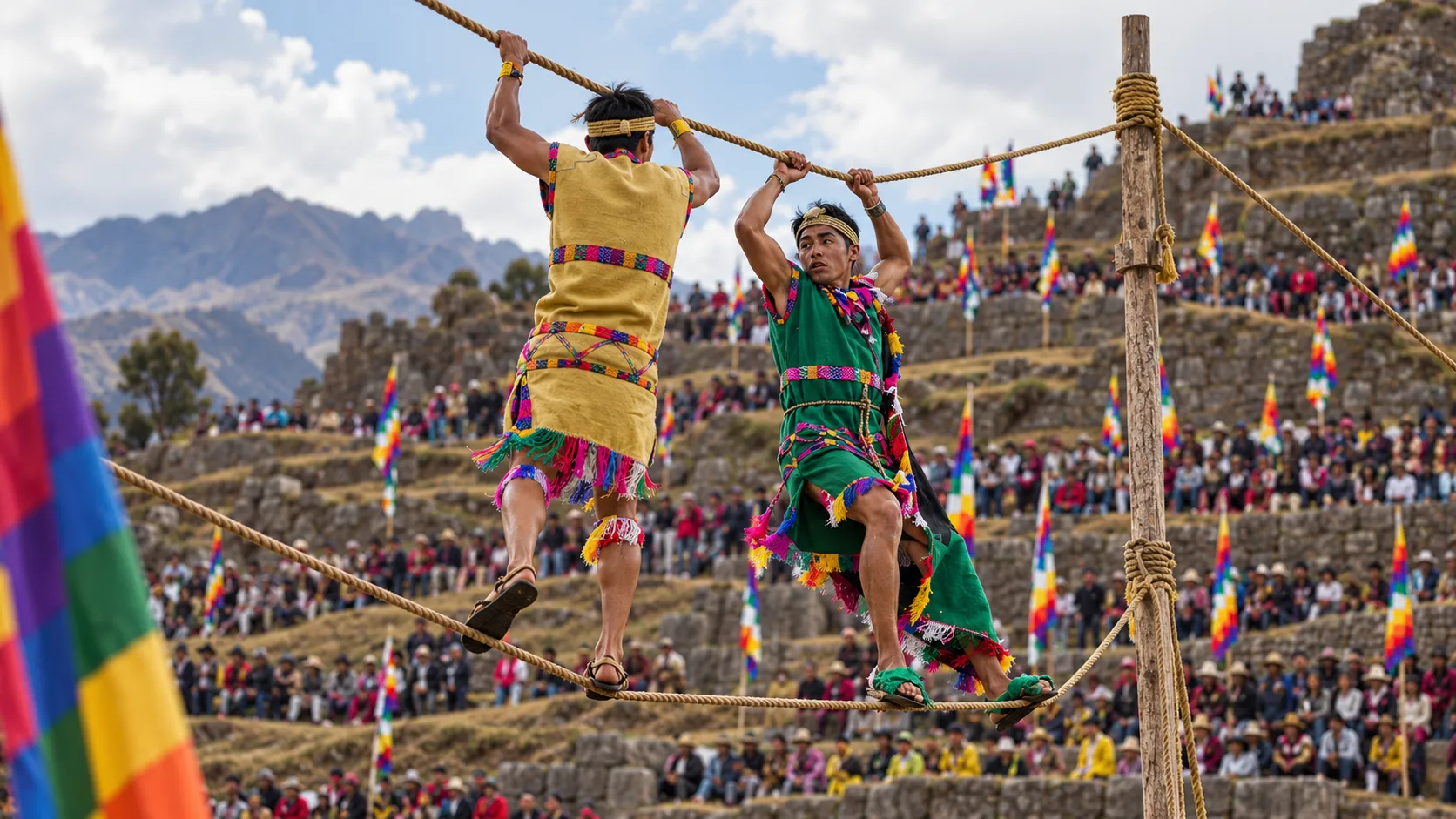
Third Sunday of September. 9 a.m. The pututos sound and 1,500 students from the National School of Sciences of Cusco set off in procession from their school to the Sacsayhuamán esplanade. They are going to compete — for real — in speed, strength, and endurance tests that replicate those the Tahuantinsuyo used to determine who was ready for adulthood. It is not a choreography. It is the Warachicuy, and in 2025 it was declared a Cultural Interest.

48 km on foot: How to reach the Señor de Huanca in Cusco

Every September 14, thousands of people walk 48 kilometers from the city of Cusco to the sanctuary of the Señor de Huanca, in the district of San Salvador, province of Calca, at 3,100 m.a.s.l. It is neither a tourist trekking trip nor an organized tour: it is a genuine pilgrimage that sets off at night from San Jerónimo and arrives at dawn on the main day. Here we explain the route, what it physical demands, and why this tradition continues to draw devotees from all over Peru and neighboring countries.

Are you planning to visit
Machu Picchu in 2026?

We would like to inform our travelers that availability for Circuit 1 and 2 for the months of September, October and November is at 85% of capacity. We recommend booking at least 3 months in advance.

New Circuits and Routes

The Ministry of Culture has consolidated the three main tours. As of 2026, Tour 2 (The Royal Route) remains the only one that allows visitors to take the classic photo from the Guardian’s House. We have adapted all our packages to ensure this access.

Digital Check-In and Biometric Verification

Say goodbye to long check-in lines! Starting this season, entry is faster thanks to the new digital check-in system. Our packages include full management of your personalized tickets to prevent errors on the state platform.

Circuit Ideal for... Clasic photo Difficulty
Circuit 1 (Panoramic) High views and photo posts Yes Low
Circuit 2 (Andean) Complete circuit through the ruins Yes Medium
Circuit 3 (Reality) Persons or reduced movement No Very low

Ask about our Machu Picchu packages

Explore the best of our land

Explore the breathtaking diversity of the Central Andes. From ancient archaeological wonders and surreal high-altitude landscapes to world-class gastronomy and Amazonian adventures, our updated 2026 guides showcase the very best of this premier global destination.